

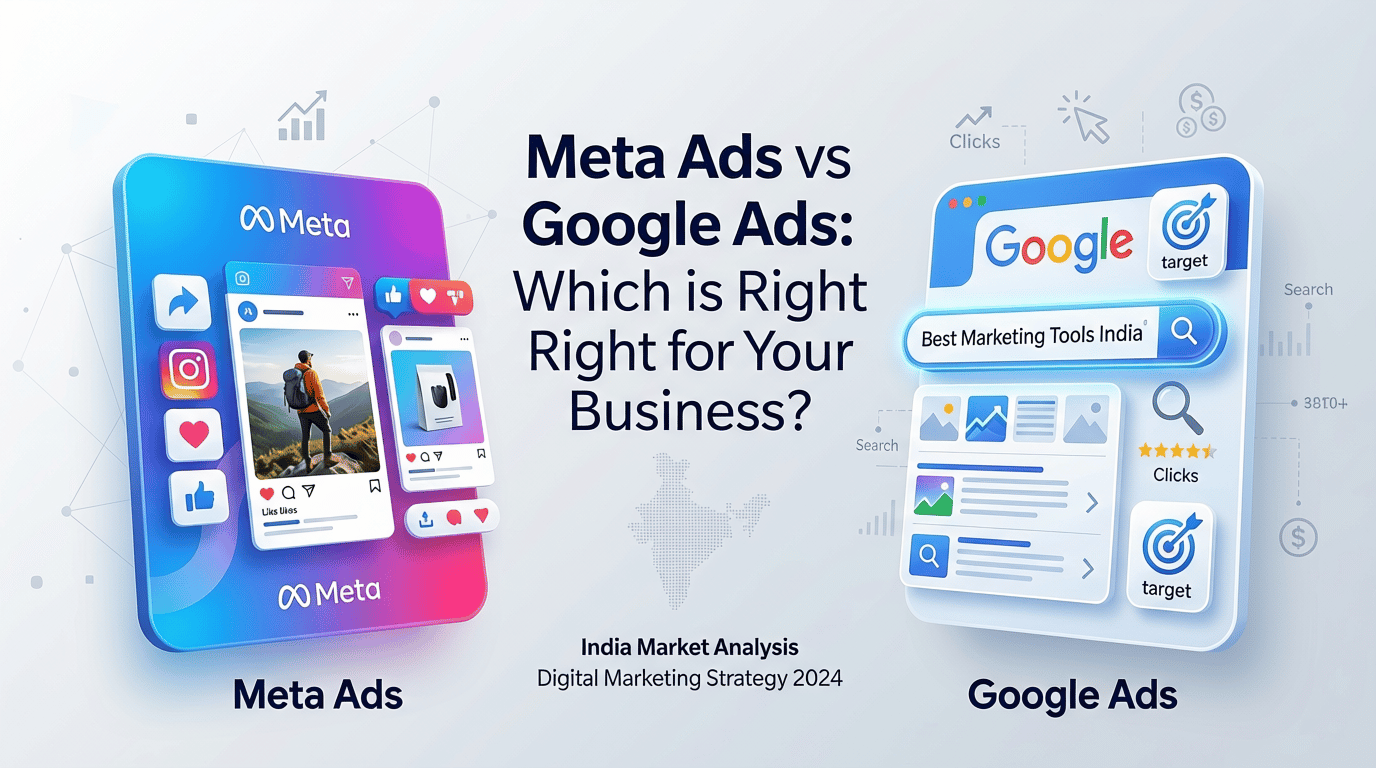
Every Indian founder who decides to invest in paid advertising faces the same question immediately.
Meta Ads or Google Ads, where does the money go first?
The wrong choice does not just waste your budget. It wastes the time spent learning the platform, building the audiences, and creating the creatives, only to realise three months later that the other platform would have worked better for your specific business.
This guide gives you a clear, honest framework to make the right decision, based on what your business sells, who your customer is, and where they are in their buying journey when you need to reach them.
The Fundamental Difference — Push vs Pull
Before comparing costs, targeting, and formats, understand the single most important difference between these two platforms.
Google Ads captures demand that already exists.
Someone searching “buy natural handmade soap online India” is actively looking for a product to purchase right now. Google puts your brand in front of that person at the exact moment of intent. You are not interrupting anyone, you are answering a question they are already asking.
Meta Ads creates demand that does not exist yet.
Someone scrolling Instagram has not searched for your product. They are not in buying mode. Meta Ads interrupt that scroll with something compelling enough to make them stop, pay attention, and eventually consider a purchase they were not planning to make.
This distinction shapes every decision that follows.
What Is Meta Ads — And What Does It Cover?
Meta Ads refers to paid advertising across all Meta-owned platforms, Instagram, Facebook, WhatsApp, and the Meta Audience Network.
According to Meta’s own advertising data, Meta reaches over 3.2 billion people daily across its platforms. In India specifically, Instagram has over 350 million users and Facebook has over 400 million, making it one of the largest advertising ecosystems in the world.
What Meta Ads can do:
- Reach people based on interests, behaviours, demographics, and life events
- Retarget people who visited your website, watched your videos, or engaged with your Instagram
- Build lookalike audiences modelled on your best customers
- Run video ads, image ads, carousel ads, story ads, and collection ads
- Drive purchases, leads, app installs, messages, and website traffic
Meta Ads works best for: D2C brands, fashion, jewellery, food, beauty, lifestyle, EdTech, real estate, fitness, and any business where the product can be shown visually and the customer can be reached through interest and behaviour targeting.
What Is Google Ads — And What Does It Cover?
Google Ads refers to paid advertising across Google Search, Google Display Network, YouTube, Google Shopping, and Google Maps.
According to Google’s Economic Impact Report, Google processes over 8.5 billion searches per day globally. In India, Google handles over 90% of all search engine queries, making it the dominant search platform by a significant margin.
What Google Ads can do:
- Appear at the top of Google search results for specific keywords
- Show product images and prices directly in search results via Shopping Ads
- Display banner and image ads across millions of websites via the Display Network
- Run video ads on YouTube before and during videos
- Appear in Google Maps when customers search for local businesses
Google Ads works best for: Any business where customers actively search before buying, services, B2B, local businesses, high-consideration products, healthcare, legal, financial services, and e-commerce with specific product searches.
The Key Differences — Side by Side
| Factor | Meta Ads | Google Ads |
|---|---|---|
| User intent | Passive — not actively searching | Active — searching for a solution |
| Targeting | Interest, behaviour, demographics | Keywords, search intent |
| Best format | Visual — video, carousel, image | Text search, shopping, video |
| Discovery | Creates awareness in new audiences | Captures existing demand |
| Best for | D2C, fashion, lifestyle, B2C | Services, B2B, local, high-intent |
| Creative requirement | High — strong visuals essential | Lower — text-based search ads |
| Learning curve | Medium | Higher |
| Minimum budget | ₹5,000/month viable | ₹10,000/month recommended |
| Average CPC in India | ₹5 to ₹25 | ₹15 to ₹80 (search) |
When to Choose Meta Ads First
Choose Meta Ads as your primary platform when:
You sell a visual product. Clothing, jewellery, food, home décor, beauty products, furniture, anything that creates desire through appearance. Meta’s visual ad formats are built for this. A 15-second video of a soap bar lathering or a Kundan necklace set catching the light will stop a scroll in a way that a text-based Google ad simply cannot.
Your customer does not know they need you yet. If you are launching a new product category or a brand new business, there are no existing searches to capture. Meta Ads create the awareness and desire that eventually leads to searches.
Your average order value is under ₹3,000. Lower AOV products need volume to be profitable, and Meta’s cost per click is generally lower than Google Search, making it more efficient for high-volume, lower-value purchases.
You want to build a brand audience. Meta’s pixel and custom audience system lets you build a remarketing audience from every person who visits your website, watches your videos, or engages with your Instagram, creating a warm pool of potential customers that gets more valuable over time.
You are a D2C brand. According to a 2024 report by Redseer Strategy Consultants, over 65% of Indian D2C brand customer acquisition happens through Meta platforms (Instagram and Facebook). If you are selling directly to consumers online in India, Meta is where your customers are discovering new brands.
When to Choose Google Ads First
Choose Google Ads as your primary platform when:
Your customer is actively searching for what you sell. If someone searches “best CA for startup registration Delhi” or “emergency plumber Gurgaon” — they are ready to hire right now. Google captures that moment. Meta cannot.
You offer a service rather than a product. Digital marketing agencies, legal firms, healthcare providers, architects, interior designers, chartered accountants — service businesses benefit enormously from Google Search Ads because the customer searches before they buy.
Your average order value is high. For products or services priced above ₹10,000 — the buyer typically researches before purchasing. They search Google, read reviews, compare options. Being visible in that search is critical. Google Ads targets that research behaviour directly.
You run a local business. A dental clinic in Pitampura, a jewellery shop in Ratlam, a restaurant in Koramangala — local businesses benefit from Google’s location-based targeting and Google Maps integration. When someone searches “dentist near me” in your area — Google Ads puts you at the top of the list.
You want to capture competitor searches. Google Ads allows you to bid on competitor brand name searches — appearing when someone searches a competitor’s name with buying intent.
What Indian Businesses Actually Spend
Understanding realistic costs helps you budget correctly from the start.
Meta Ads average costs in India (2026):
- Average Cost Per Click (CPC): ₹5 to ₹25 for most categories
- Average Cost Per 1,000 Impressions (CPM): ₹40 to ₹150
- Average Cost Per Purchase (D2C products): ₹200 to ₹800 depending on category and AOV
Google Ads average costs in India (2026):
- Search Ads CPC: ₹15 to ₹80 for most commercial keywords
- Shopping Ads CPC: ₹8 to ₹30 for product searches
- Display Ads CPM: ₹20 to ₹80
- YouTube Ads CPV (cost per view): ₹0.25 to ₹1.50
These are averages. Competitive categories like insurance, loans, real estate, and legal services have significantly higher CPCs on Google, sometimes ₹200 to ₹500 per click. Fashion, food, and lifestyle on Meta tend to stay in the lower ranges.
According to WordStream’s Industry Benchmarks, the average Google Ads conversion rate across industries is 3.75% for search and 0.77% for display. For context, well-optimised Meta Ads campaigns for D2C brands in India typically see purchase conversion rates of 1% to 4% depending on product and creative quality.
The ROAS Question — What Should You Expect?
ROAS — Return on Ad Spend — is the primary performance metric for both platforms.
ROAS = Revenue generated ÷ Ad spend
Realistic ROAS benchmarks for Indian businesses:
| Business Type | Meta Ads ROAS | Google Ads ROAS |
|---|---|---|
| D2C fashion / lifestyle | 2x to 5x | 3x to 7x (Shopping) |
| Natural beauty / FMCG | 2x to 4x | 3x to 6x |
| Jewellery | 3x to 8x | 4x to 10x |
| Services / B2B | Not primary metric | 5x to 20x |
| EdTech | 2x to 4x | 3x to 8x |
| Local services | 3x to 6x | 5x to 15x |
Google Shopping Ads consistently deliver higher ROAS than Meta for products with active search demand, because the buyer is already in purchase mode. Meta’s strength is volume and discovery, especially for products that create impulse purchases.
The Role of Creative — Why Meta Demands More
The single biggest operational difference between running Meta Ads and Google Ads is creative requirement.
Google Search Ads are primarily text-based. A well-written headline, a strong description, and the right keywords are the primary success factors. The skill is in keyword research and bid strategy.
Meta Ads are visual-first. The image or video is everything. According to Meta’s own research, creative quality is responsible for 56% of campaign performance variation, more than targeting, placement, or budget combined.
This means Meta Ads require a consistent pipeline of fresh creative. A single ad that performs brilliantly in Week 1 will experience creative fatigue by Week 3 as the same audience sees it repeatedly. Running Meta Ads without a plan for ongoing creative production is one of the most common reasons campaigns underperform.
If you are a business without the capacity to produce fresh video and image content regularly, Google Search Ads may be the better starting point.
Can You Run Both — And Should You?
Yes, and for most growing Indian businesses, running both platforms simultaneously is the most effective long-term strategy.
Here is how the two platforms complement each other:
Meta builds awareness → Google captures the resulting search.
When someone sees your brand on Instagram three times, they become familiar with the name. When they are ready to buy, they search your brand name on Google. Without Google Ads, a competitor’s ad may appear above your organic listing for your own brand name, and you lose the customer you spent Meta budget to warm up.
Google captures active buyers → Meta retargets the ones who did not convert.
Someone clicks your Google Shopping ad, visits your website, but does not purchase. Meta retargeting reaches that same person on Instagram the next day with the exact product they viewed, bringing them back to complete the purchase.
The most efficient media mix for a growing Indian D2C brand looks like this:
- 60% Meta — brand awareness, discovery, prospecting
- 30% Google — Shopping ads, branded search, high-intent keywords
- 10% Remarketing — across both platforms, targeting warm audiences
Starting Small — Which Platform to Start With by Budget
Under ₹10,000/month total ad spend: Start with Meta Ads only. Google Search requires a higher minimum spend to generate enough data for meaningful optimisation. Meta can deliver results at ₹5,000 to ₹8,000/month for D2C and lifestyle brands.
₹10,000 to ₹30,000/month: Meta as primary (70%) + Google Shopping or Search for your highest-intent keywords (30%). This combination starts building the full funnel at a manageable budget.
₹30,000 to ₹1,00,000/month: Full dual-platform strategy — Meta for discovery and remarketing, Google for Shopping, Search, and YouTube pre-roll. At this level, the two platforms compound each other significantly.
Above ₹1,00,000/month: Add YouTube Ads, Google Display remarketing, and expand Meta to broader lookalike audiences. The flywheel is spinning — the priority shifts to optimisation and scaling what is working.
The Three Mistakes Most Indian Businesses Make
Mistake 1 — Choosing based on what they know, not what works. Founders who use Instagram personally often start with Meta. Business owners who search Google often start there. The right choice is based on your customer’s behaviour, not your own.
Mistake 2 — Running both platforms with too little budget on each. Splitting ₹10,000 equally between Meta and Google gives you ₹5,000 on each, not enough for either platform to gather meaningful data and optimise. Concentrate your budget on one platform first. Scale the other when the first is profitable.
Mistake 3 — Turning off campaigns too quickly. Meta’s algorithm needs a minimum of 50 conversion events per ad set per week to exit the learning phase. Google Search campaigns need 30 to 50 clicks before conversion data is statistically meaningful. Turning campaigns off after 5 days because they are not immediately profitable is the most expensive mistake in paid advertising.
Do You Need a Performance Marketing Agency?
Managing Meta Ads and Google Ads professionally requires significant expertise, audience strategy, creative direction, bid management, A/B testing, attribution modelling, and continuous optimisation.
Many Indian businesses try to run their own ads initially, and there is value in understanding the platforms. However, an experienced agency will typically achieve 30% to 50% lower cost per acquisition than a self-managed account, because they bring pattern recognition from hundreds of campaigns across categories.
If you are evaluating performance marketing agencies, read our guide on how to choose a digital marketing agency in Delhi, it covers the specific questions to ask before you sign anything.
For D2C brands specifically, our guide on how to grow a D2C brand in India with performance marketing covers the complete strategy, from campaign structure to creative testing to ROAS optimisation.
And if you want to understand what professional performance marketing management costs in India, read our digital marketing agency cost guide for a transparent breakdown.
The Decision Framework — A Simple Checklist
Use this checklist to decide where to start:
Start with Meta Ads if:
- You sell a visual, lifestyle, or D2C product
- Your customer does not actively search for your product yet
- Your AOV is under ₹5,000
- You can produce fresh visual content regularly
- You want to build brand awareness and a retargeting audience
Start with Google Ads if:
- You sell a service or high-consideration product
- Your customer actively searches before buying
- Your AOV is above ₹5,000
- You run a local service business
- You want to capture buyers who are ready to purchase right now
Run both when:
- You have a monthly ad budget of ₹30,000 or more
- Your Meta campaigns are profitable and you want to scale
- You want to capture brand searches driven by your Meta awareness campaigns
About Tomto Lemon
Tomto Lemon is a New Delhi-based brand growth and digital marketing agency specialising in performance marketing for D2C brands, service businesses, and founders across India.
We manage Meta Ads and Google Ads campaigns across categories including jewellery, EdTech, fashion, agrochemicals, fitness, architecture, and financial services. Our approach starts with understanding your business — margins, customer lifetime value, and growth goals — before recommending a single rupee of ad spend.
If you want a clear recommendation on which platform is right for your specific business, get in touch with us here. The first conversation is always free and always straight.
Published by Tomto Lemon Creative | Delhi’s Brand Growth & Digital Marketing Agency tomtolemon.com | creative@tomtolemon.com | +91 88517 02378